Cubism
Artistic Movements, Periods and Styles in 5 Points
We could make this publication thanks to small donations. How is 3 minutos de arte supported?
Cubism
- Picasso and Braque were the initiators of the movement at the beginning of the 20th century. The movement represented images in a way that revolutionized the history of art forever.
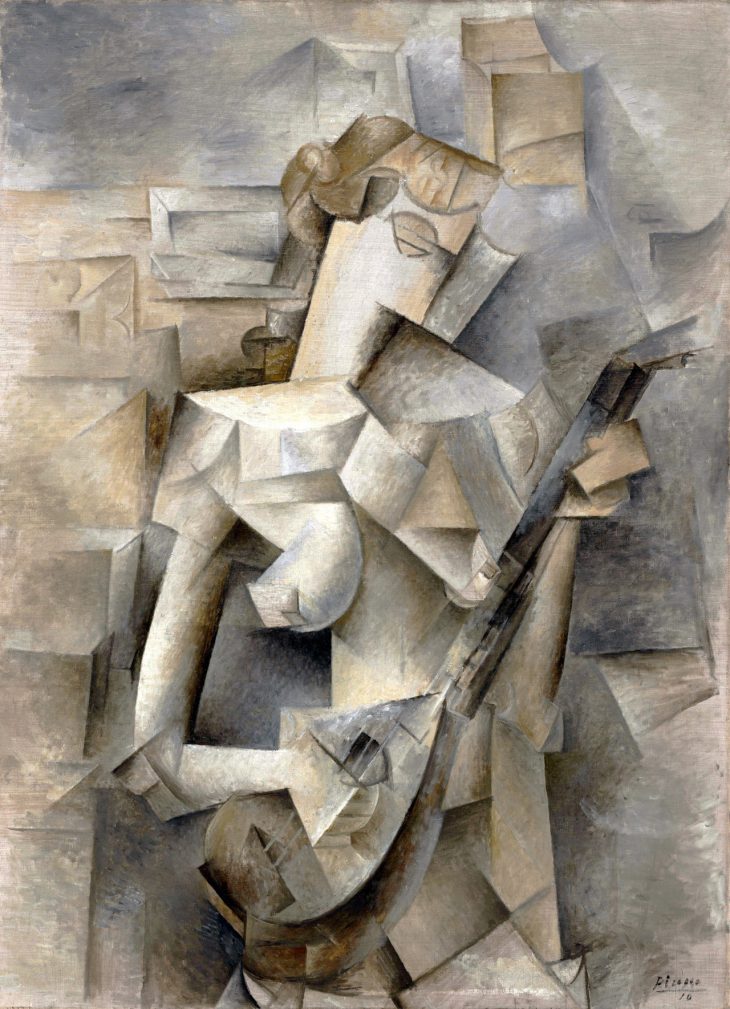
- The represented objects and human figures are seen “geometrized” and from different perspectives at the same time.
- It is as if the figures were “flattened” on the canvas and their different sides were sharing the same two-dimensional space.
- This definitive break with the traditional use of perspective and space (which had been developing since the Renaissance) would be decisively functional to all 20th century painting, which used to a greater or lesser extent the “deformation” of figures and perspectives to express feelings and moods (“emotive distortion”).
- There are two stages in cubism. Analytical Cubism analyzes the structure of things considering their multiple perspectives, they have a fragmentary appearance. The works are usually monochrome, or with very few dark, muted colors. In Synthetic Cubism, the resource is no longer so much an end in itself, but a tool of expression. The image is simplified, coloring returns, and collage is incorporated as a novelty.
Representative artists: Picasso, Braque, Gris, Léger, María Blanchard.
Image: Girl with a Mandolin (Fanny Tellier) (1910). Analytical Cubism. Picasso.
Recommended links:
Fundamental Differences between Analytic and Synthetic Cubism.
Characteristic Elements of Analytical Cubism.
Fundamental Paintings to Understand the History of Painting: Les Demoiselles d’Avignon, Picasso.
Fundamental Paintings to Understand the History of Painting: Mont Saint-Victoire, Cézanne.
María Blanchard, the Most Important Female Painter of Cubism.
You can also find more material using the search engine.


0 Comments