Sandro Botticelli
Fundamental Paintings to Understand the History of Painting
We could make this publication thanks to small donations. How is 3 minutos de arte supported?
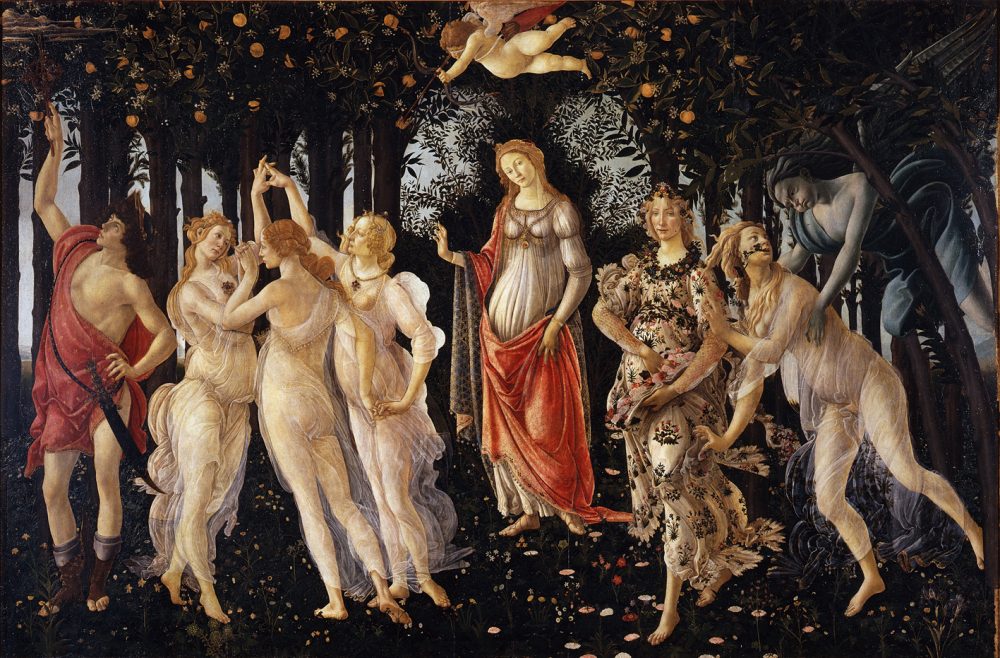
Spring (ca. 1482). Sandro Botticelli.
Tempera grassa on wood. 203 cm x 314 cm
Galleria Uffizi. Florence, Italy.
Sandro Botticelli was the great artist of the Early Renaissance —the Quattrocento—. There was a new conception of the man and the world. There was human-centered point of view (anthropocentrism) and life was not so much around God and the power of the Church. There was a return to the values of the culture of Greco-Roman Antiquity.
Although Botticelli started with works on religious themes, when he worked for the Medici circle that changed. There was a “rebirth” of the values of the past and the Neoplatonic philosophy, concerned with man, his origin, his destiny, reached new heights.
Botticelli then became the greatest interpreter of the Neoplatonism of the time, fusing Christian and pagan themes, introducing scenes and characters full of symbolism and philosophical content.
Venus, symbolizing the power of love, would be the first divinity of the Neoplatonists, and this explains her presence in so many of Sandro’s works.
Botticelli was not among the great innovators of the Renaissance. He was not very interested in realism; his concern was to give the human figure delicacy, grace, sentimentality.
He was not concerned about perspective; he stylized the figures and treated nature as decoration, seeking beauty above all. In this painting he made almost a “botanical inventory” with at least 138 species of flowers which grow in the Florentine hills.
The exact meaning or allegorical sense of this work is still debated, since Botticelli’s whole symbolism is complex. Apparently we are in the gardens of Venus. We can see Venus, the three Graces, Mercury, Cupid, Zephyrus —the spring wind— who pursues the nymph Chlori to marry her. Chlori is then portrayed after her transformation into Flora, Roman spring goddess.
One thing is crystal clear: no one disputes that this is one of the most beautiful paintings of the entire Renaissance.
Recommended links:
Botticelli and the Return to Mythology.
Stories Behind Works of Art: The Birth of Venus, Sandro Botticelli.
The Madonnas of Botticelli and the Differences with those of Raphael.
Fra Angelico and the Early Renaissance.
You can also find more material using the search engine.
Would you like to support 3 minutos de arte?
Our project.


0 Comments