Piero di Cosimo
Fundamental Paintings to Understand the History of Painting
We could make this publication thanks to small donations. How is 3 minutos de arte supported?
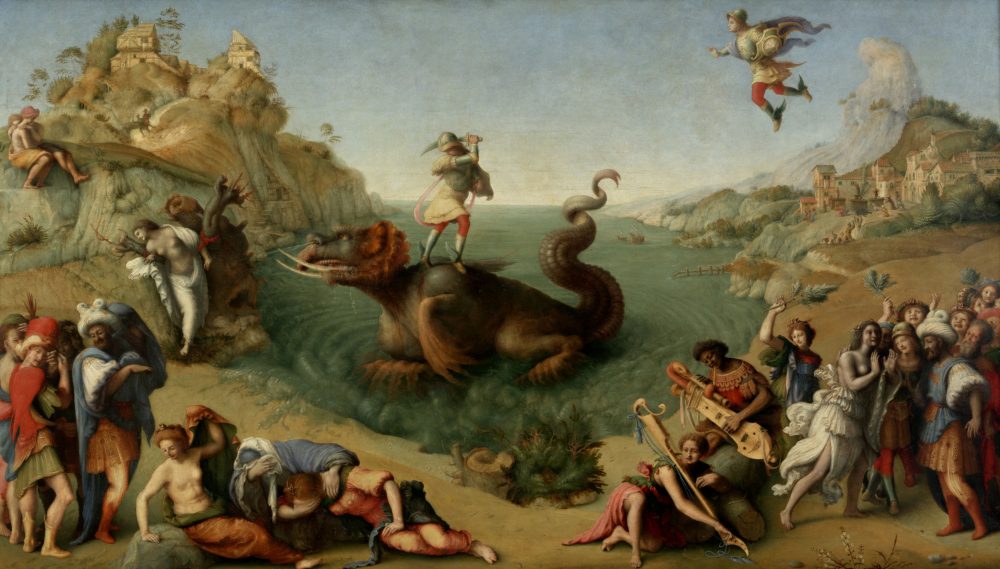
Perseus Freeing Andromeda (ca. 1510-15). Piero di Cosimo
Oil on table. 70 cm x 123 cm
Uffizi Gallery. Florence, Italy
Piero di Cosimo was an artist with an unparalleled imagination. And he was one of the first famous painters in history to be considered a “cursed artist.”
Why was he so called? He was a marginal artist, who, despite his talent, remained outside the patronage of the Medici and had to survive with the occasional private commission (he was a very good portraitist), because he lived almost all the time locked up, avoiding any comfort, with an enthusiasm for his work that made him forget everything else. (It is said that he used to boil a huge number of eggs and eat them according to his appetite, so as not to waste time eating).
Vasari, the biographer of that time, said that Di Cosimo spent most of his life in solitude, in seclusion, “more like a beast than a man.”
As could not be otherwise, his works have an unconventional look, something we notice from the very first moment, from the coloring itself. We find mythology, fantastic worlds, horrendous, bizarre beings, beasts, and satyrs in them. And many of his scenes seem like dreams, which are difficult to decipher.
That is why, four centuries later, Piero di Cosimo was “rediscovered” and admired by the surrealists (as happened with Bosch, whose work The Garden of Earthly Delights is from the same period as the one chosen).
Di Cosimo’s painting is historically located in a transition that oscillates between Renaissance and Mannerist painting. Let us remember that mannerism was an “evolution” of the Renaissance on the way to the Baroque, and was characterized by a more garish coloring, a certain dramatism (which was in crescendo until the Baroque) and an “exaggerated” concern for representations that require great technical virtuosity to demonstrate the style (the “maniera”) of the artist. In short, elements that gave the works a certain artificial tone, not very simple, and not very natural.
Piero di Cosimo was a cursed painter of the Renaissance. And his eccentric life was one of the first examples that reinforced the conclusion that Cézanne provocatively reached in the 19th century: the most seductive aspect of art is the artist’s own personality.
Recommended links:
Characteristic elements of Renaissance painting, each with an example.
Timeline: The Four Greatest Painters of the Italian Renaissance.
The Stanze of Raphael and the High Renaissance.
Why is La Gioconda the most famous painting in the world?
You can also find more material using the search engine.


0 Comments