The Venetian School of the 16th Century
Artistic Movements, Periods and Styles in 5 Points
We could make this publication thanks to small donations. How is 3 minutos de arte supported?
The Venetian School of the 16th Century
- Venice was a very powerful city for centuries, and the art and artists it produced were many and left their mark on history. This is called the “Venetian School” in general, and as throughout those centuries (between the 15th and the 18th centuries), there were many manifestations with different characteristics, we are going to focus on the 16th century, the moment of apogee, when the artists shone with their own light, along with the other geniuses of the Renaissance.
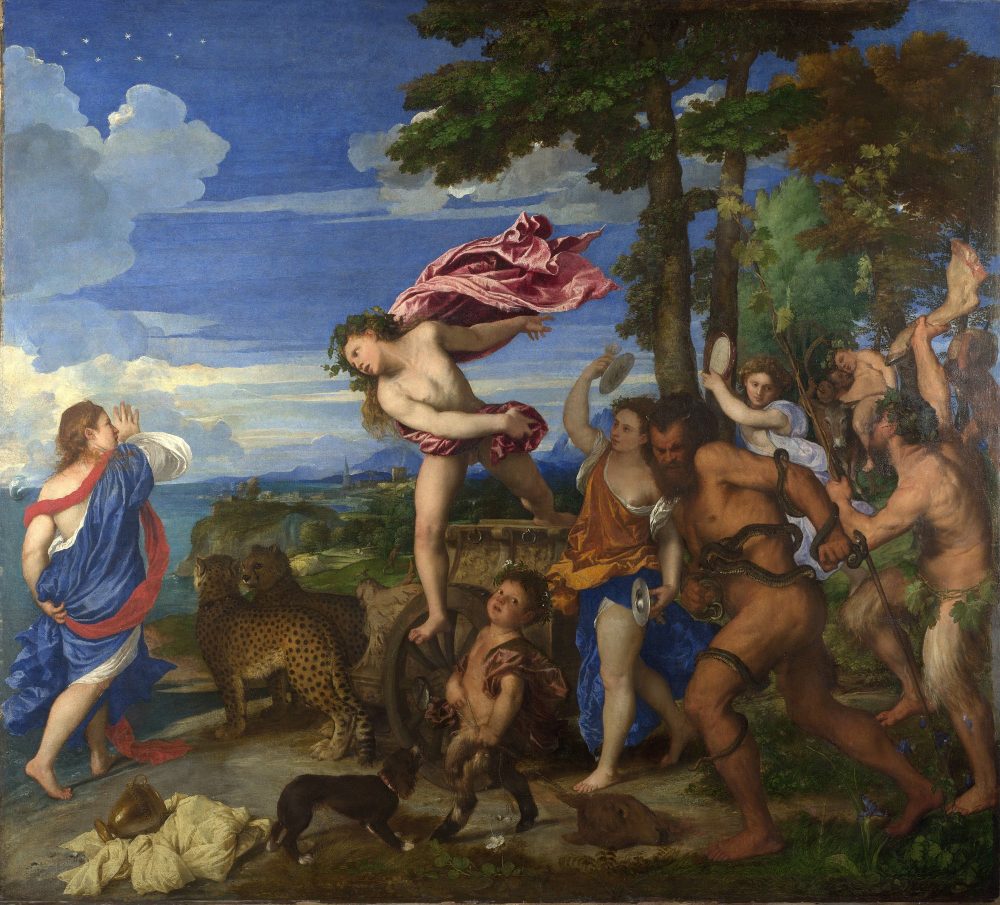
- The use of oil that Antonello da Messina brought from Flanders (when the Venetian school was taking shape in the 15th century) became popular in Venice. And the color palette that we see in general is strong, bright, and with violent contrasts. The color that usually stands out is ultramarine blue, and it is perhaps a key to recognizing that a painting belongs to that School.
- The paintings are very bright. A characteristic usually associated to the fact that Venice is a very bright city. And precisely, related to the obsession with light, atmospheric conditions, and color, we find that the use of atmospheric perspective gains strength: a perspective that is obtained not by vanishing points but by variations in light and color.
- Mythological stories are one of the most popular themes (as in this painting). In addition, we can see how the landscape becomes increasingly important, and it is not just a background. One of the fundamental examples is The Tempest, by Giorgione, which is regarded as the first “emotional” landscape (a work where the landscape, in this case stormy, serves to reflect the artist’s state of mind).
- The Venetians started to use the loose brushstroke, which we like to call the “Venetian brushstroke.” The figure is produced with modest touches of color delivered with ease and quickness, rather than the contour being sketched and then the inside being colored. Something that gives the works the appearance of being unfinished at first glance, but which makes them appear more dynamic than those in which every detail has been meticulously worked on. This brushstroke was later adopted by Rubens, Rembrandt, Velázquez, and other great artists of all time, until it became a fundamental resource of Impressionism.
Representative artists: Giorgione, Catena, Palma Il Vecchio (Old Palma), Palma il Giovane (Young Palma), Titian, Tintoretto, Veronese.
Image: Bacchus and Ariadne (1520-23). Titian.
Recommended links:
Characteristic Elements of Venetian School.
Fundamental Painters of the Venetian School (15th and 16th Centuries).
Artistic Movements I: from Classical Antiquity to Rococo.
Ultramarine Blue in Venetian Painting.
Stories: The Origin of the Milky Way (1575), by Tintoretto.
You can also find more material using the search engine.


0 Comments