The Return to Order
Artistic Movements, Periods and Styles in 5 Points
We could make this publication thanks to small donations. How is 3 minutos de arte supported?
The Return to Order
- Each artistic movement or current of thought usually arises as a reaction to another movement or current. And in turn, once it starts to prevail, it usually generates a reaction that contradicts it. It is like a kind of pendulum that moves from one extreme to the other. The return to order is a movement that refers to the classical “order.” It is the pendulum returning to classical art.
- This movement took place at the end of the First World War (it is usually placed between 1918 and 1936, until a little before the Second World War, that is why it is said to be a “movement of the interwar period”). And it was born as a reaction to the furor of the avant-garde movements. It is as if, in the face of a chaotic world full of atrocities caused by the war, there were artists who “rejected” going forward, rejected “progress,” to take refuge in the harmony and calm of the past.
- It was not that modern language was totally rejected, but rather that certain modern resources were fused with a more traditional, more “classical” approach to art (figurativism, harmony, serenity).
- Although this is not a movement like those of its time (which usually have a “manifesto”), the writer, painter, filmmaker, and critic Jean Cocteau wrote in 1926, Le rappel à l’ordre (The Return to Order), a book of essays that accelerated the dissemination of the theoretical foundations of this “reaction” in art.
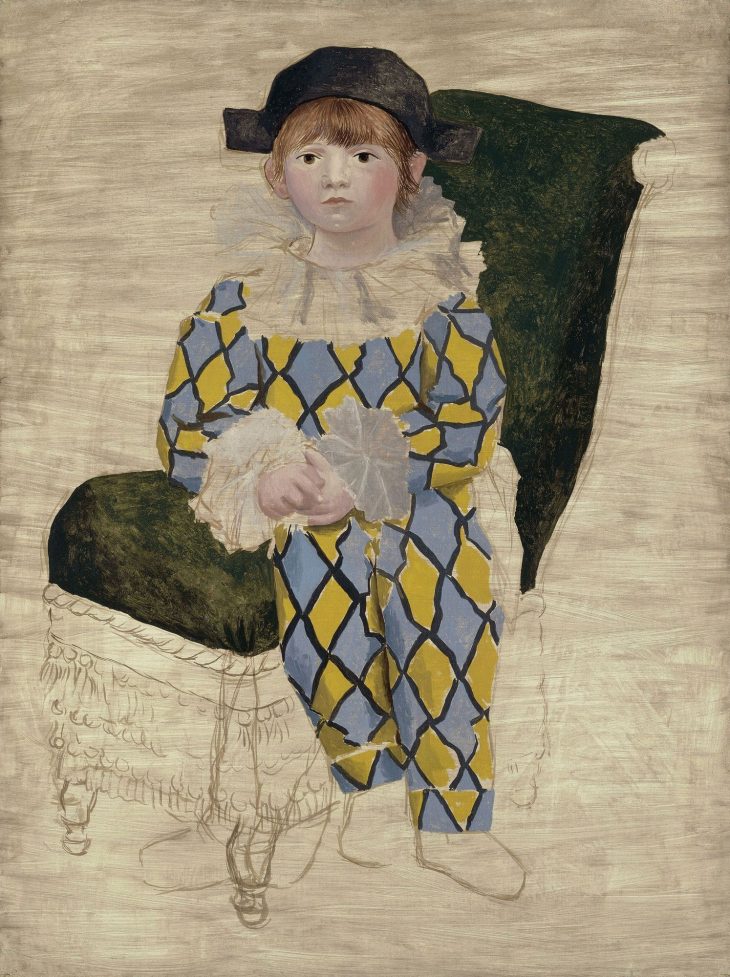
- The most notorious case, and one that is considered key to this movement, is when an innovator par excellence like Picasso leaves Cubism to paint with a “classical” conception of painting for several years. A stage that he would later abandon, after 1925, to enter the Surrealist period of his work.
Image: Paul as Harlequin, 1924, Picasso
Recommended links:
Artistic Movements, Periods and Styles in 5 Points: When does Modern Art Start?
“Learn the rules like a pro, so you can break them like an artist.”
Artistic Movements I: from Classical Antiquity to Rococo.
Artistic Movements II: from Neoclassicism till the end of the 19th century.
You can also find more material using the search engine.
Would you like to support 3 minutos de arte?
Our project.


0 Comments