Superflat
Artistic Movements, Periods and Styles in 5 Points
We could make this publication thanks to small donations. How is 3 minutos de arte supported?
Superflat
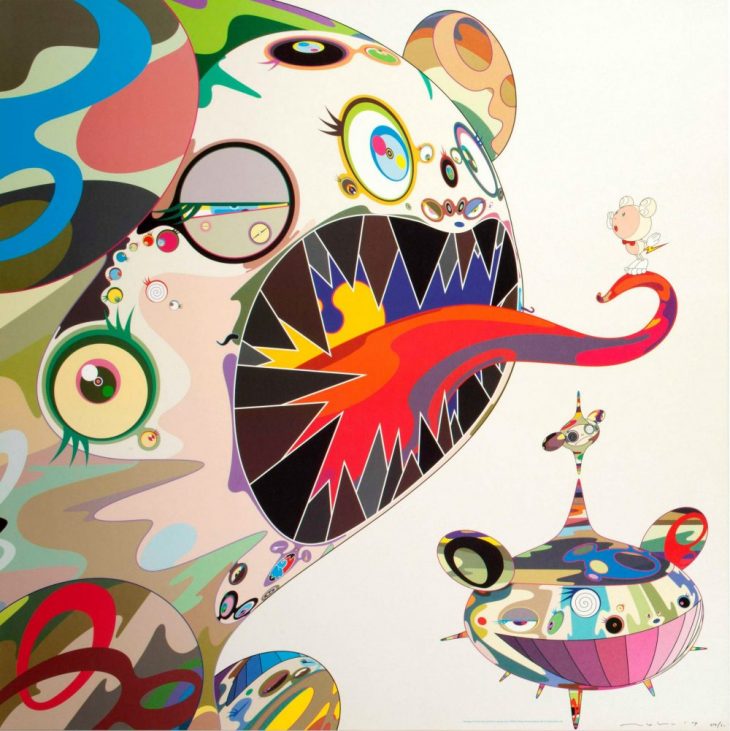
- Superflat is a movement that was born within Japanese culture and became popular in the year 2000. Broadly speaking, we could define it as the combination of traditional Japanese art (think of the ukiyo-e print, as one of the best known examples) with pop art (as that of Andy Warhol in the sixties), as well as representative elements of the Japanese pop culture such as manga and anime (we refer to Japanese comics and cartoons which have transcended frontiers and are admired and “consumed” in many parts of the planet.)
- Takashi Murakami, the movement’s leader, says, “What is important in Japanese art is the sense of flatness. Our culture does not have 3-D.” Flatness is a characteristic that has been maintained throughout that cultural tradition. The term “superflat” refers to the fact that there is an evolution reinforcing two-dimensionality.
- But “flat” does not only refer to the dimension in which the artist works. It also refers to the flat consumer culture of post-war Japan (consumption that is criticized for its superficiality at times). Flat, because all social classes participate indistinctly. And flat also, because a valuable work of art, for example, can become merchandise accessible to everyone in the form of trinkets.
- Likewise, in the Superflat Manifesto written by Murakami himself, he refers to a future with a sense of flatness, a future with fewer differences, and with more homogeneity: “The world of the future might be like Japan today: superflat. Society, customs, art, culture, all are extremely two-dimensional.”
- A child of its time, like all art, superflat is art but at the same time it is commercialization, marketing, and merchandising. Traditional painting and sculpture are intertwined with the digital, filmmaking, graphic design, the development of commercial products and with fashion. Art is “consumed” on a daily basis, it is part of our environment (one of the concepts that pop had already installed a few decades earlier).
Representative Artists: Takashi Murakami, Yoshitomo Nara, Aya Takano, Mahomi Kunikata, Chiho Aoshima
Image: Homage to Francis Bacon (Study of George Dyer) (2004). Takashi Murakami
Recommended links:
Francis Bacon: “My painting is not violent; it is life that is violent.”
You can also find more material using the search engine.


0 Comments