Pont-Aven School
Artistic Movements, Periods and Styles in 5 Points
We could make this publication thanks to small donations. How is 3 minutos de arte supported?
Pont-Aven School
- Pont-Aven is a picturesque place, and artists who wanted to escape from Paris and did not have a large budget went there to spend the summer in the 19th century. In 1886 Paul Gauguin arrived there for the first time, and he and the whole group of painters around him were called the Pont-Aven School.
- The beginning of the fascination with primitive art and exotic cultures can be seen.
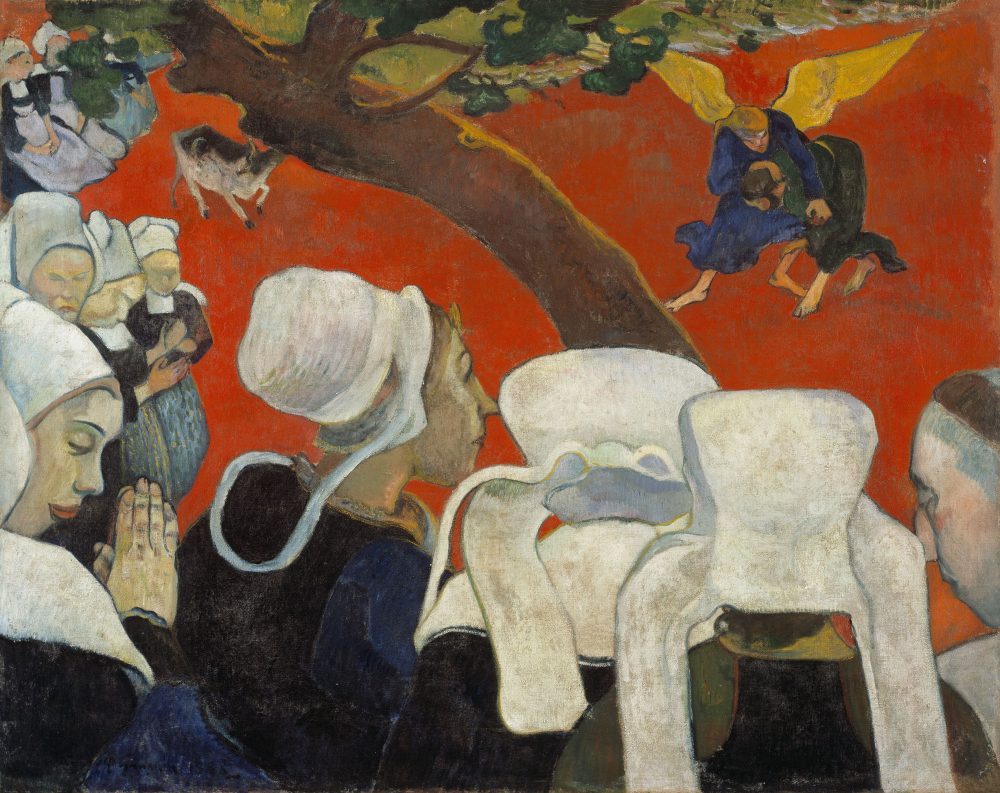
- The meeting of Gauguin and a very young painter named Émile Bernard was very important. Bernard painted in a style that he himself called Cloisonnism: drawings with well-marked edges and areas of pure and intense color, like the stained glass windows of the Middle Ages, flat figures, without shadow, and an obvious inspiration from the 18th-century Japanese woodblock prints. The group was fascinated, and they experimented with their ideas.
- They also developed Synthetism. “Synthesis” refers to a combination, a mixture (from many things you get one). They moved away from imitating nature and combined the artist’s emotional intervention with the pursuit of form and color purity. (It is very similar to how we would describe twentieth-century painting.)
- Gauguin, who was increasingly obsessed with the authenticity of the primitive, traveled to Tahiti in 1889 for the first time, and the group dispersed. However, the foundations for most of what was to come in art history had already been laid.
Representative artists: Gauguin, Bernard, Filiger, Sérusier, Meijer de Haan.
Image: Vision after the Sermon (1888). Paul Gauguin
Recommended links:
The First Painting of Synthetism?
Fundamental Paintings: When Will You Marry? (1892), Paul Gauguin.
Gauguin: “Art is what you see, the emotion it causes you.”
You can also find more material using the search engine.


0 Comments