Expressionist Portrait
Techniques. Resources. Creative processes. Genres.
We could make this publication thanks to small donations. How is 3 minutos de arte supported?
Expressionist Portrait
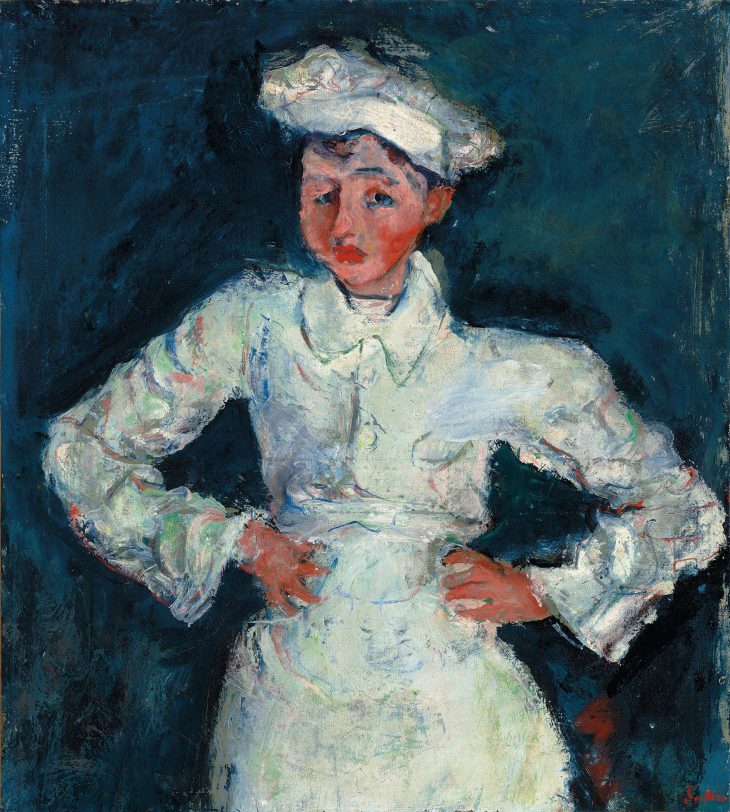
Expressionist painting in general is the one that does not paint reality as it is, but deforms it to express something.
In an expressionist painting, we find exaggeration and distortion in shapes, perspectives, dimensions, or colors, in order to fundamentally express the artist’s state of mind (one of the pioneers of Expressionism, Edvard Munch, said that “one sees according to one’s mood.”)
The feeling matters more than the physical. The artist’s vision is more important than the appearance of things.
We call this distortion “emotive distortion,” and when it comes to an expressionist portrait, its function is to delve into the psychological characteristics or the state of mind of the sitter and not so much to express the artist’s feelings.
The artist does not copy physical traits but transmits spiritual, psychological, and emotional traits.
The artist deforms and the portrait, curiously, becomes more “real”, more alive.
Image: The Little Pastry Cook (1927). Chaim Soutine.
Recommended links:
Characteristic Elements of Expressionist Painting.
The Scream (1893), Edvard Munch.
The Bridge and the Tools of Expressionism.
Soutine’s Expressionist Landscape
You can also find more material using the search engine.


0 Comments