William-Adolphe Bouguereau
Fundamental Paintings to Understand the History of Painting
We could make this publication thanks to small donations. How is 3 minutos de arte supported?
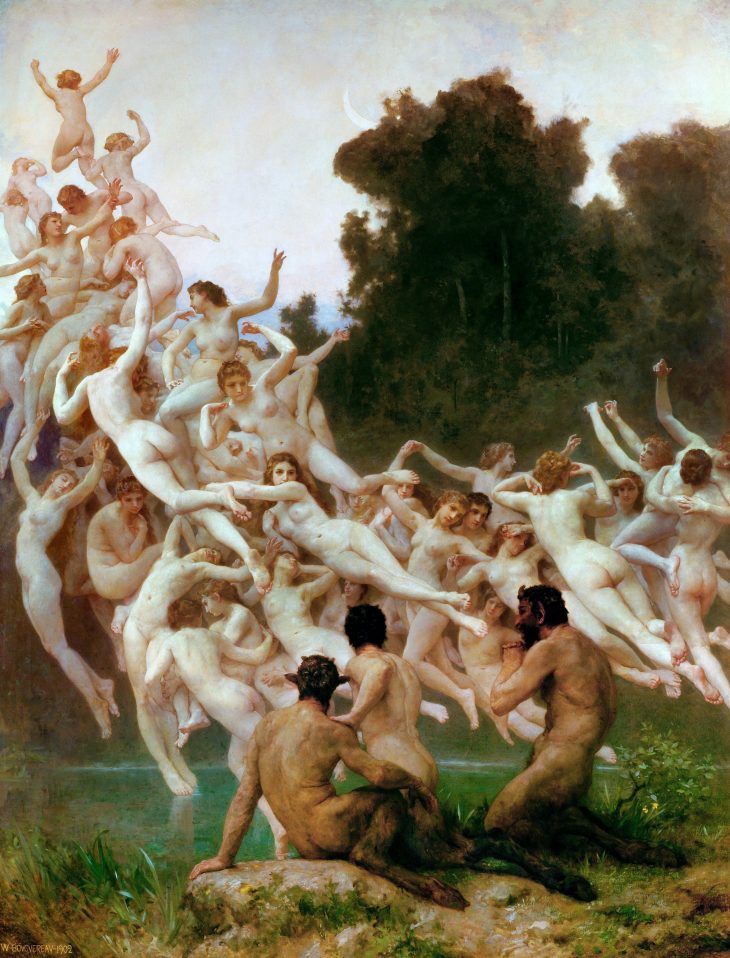
Les Oréades (1902). William-Adolphe Bouguereau
Oil on canvas. 236 cm x 182 cm
Musée d’Orsay. Paris, France
The “academic” works have a great technical quality; they reach the highest possible perfection for their time, and this is because they are conceived with the standards dictated by the Academies of Arts.
The standards of beauty are established beforehand (they are not discovered by the artist through direct experience) and are usually to the taste of a classical, majority audience.
But in history, as in life itself, from time to time there is a weariness due to so much perfection, so much order, so much “neatness,” so much “doing what pleases everyone,” and therefore rebellion breaks out and a movement opposing all arrives with force and accuses academicism of being rigid and of not allowing the freedom of the artist.
Bouguereau is an excellent example of an exquisite, academic artist. He was condemned and abhorred in history for being an enemy of progressive ideas. He was the maximum figure of official art, in an era in which Constable, the Impressionists, the Post-Impressionist geniuses, and modernity rebelled against it. (He recovered some prestige at the end of the 20th century, since his perfect technical quality, undeniable at a simple glance at each of his paintings, should be recognized.)
His themes are the idealized and evocative themes that interested the bourgeois: beautiful women, shyly erotic nudes, tenderness, charming children, and a kind of “sentimental mythology.”
For the great geniuses of his time who detested him, his paintings were complacent, “for the hypocritical bourgeois.” (An anecdote: when Cézanne was rejected from the annual convocation of the Academy, he claimed to have been “excluded from the Salon Bouguereau.”)
But how well he paints.
Recommended links:
Jean-Léon Gérôme and Diogenes.
You can also find more material using the search engine.


1 Comment
Miljenka · 27 June, 2024 at 6:04 am
John Konstable ulje na platnu posjedujem sliku identičnu kao ova. Kako je moguće da postoje dvije takve? Original je navodno u Londonu. Ako mogu dobiti odgovor? Hvala