Water Lilies at the Musée de l’Orangerie
Stories behind the Works of Art
We could make this publication thanks to small donations. How is 3 minutos de arte supported?
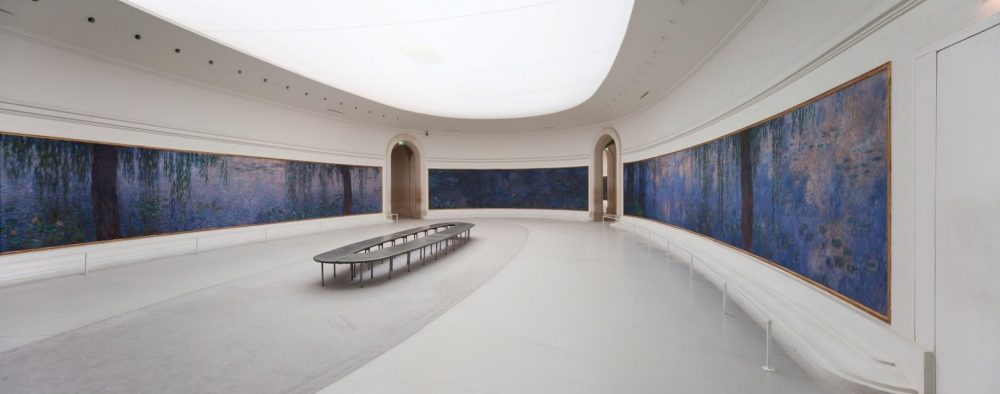
Water Lilies at the Musée de l’Orangerie, Paris. Monet.
As an image, we have chosen a part of the work (which cannot be included in a single photograph), including its surroundings, since it is not a painting but a whole experience.
The double oval room where this work is shown is called the Sistine of impressionism, in reference to the Sistine Chapel painted by Michelangelo. It has the shape of the symbol of infinity, which is very significant. The viewer is surrounded by images of water lilies, willows, reflections of light on water and clouds, which together amount to almost a hundred linear meters of the purest Impressionism.
Monet painted these panels in his garden at Giverny, and gave them as a gift to the French state when the armistice was signed at the end of 1918 (when Germany surrendered in the First World War), with the idea that they would be a symbol of peace.
The painter himself participated in the design of the rooms and the way in which the panels would be exhibited, including the entrance of natural light, so that, according to the Impressionist ideology, their appearance would be modified at different times of the day and according to the atmospheric conditions.
The rooms for the Water Lilies were not ready until 1927, a few months after the painter’s death. At that time, this monumental work did not acquire its real dimension in the soul of the public, which was no longer passionate about Impressionism at a time dominated by the dazzling progress of modern painting and its avant-garde movements.
When did the real success of this work explode and it became venerated and even compared to the Sistine? In the 1940s, when Abstract Expressionism began to cause a furor.
And what relation do these water lilies have with Abstract Expressionism, which took place much later? The water lilies, with their reflections on the water, as well as the later paintings of the Japanese bridge, somehow remind us of the abstraction of Pollock’s dripping paint. Or these huge panels take us to Rothko’s huge paintings with colored areas, where the viewer is immersed in a sensory experience.
At that point, the public and critics turned their attention back to Monet and everybody started to revere the oval salons of l’Orangerie.
Monet said that this work creates “the illusion of an endless whole, of a wave with no horizon and no shore.”
And the spectators, immersed in this whole, understand that the gaze can discover an entire universe in a flower, in a reflection in the water, in the slightest ray of light of a sunset.
Recommended links:
Characteristic Elements of Impressionist Painting.
Impression, Sunrise (1872), Claude Monet.
The Last Paintings of Monet: a Touch of Expressionism?
You can also find more material using the search engine.


0 Comments