The medium is the message
Techniques. Resources. Creative Processes. Genres
We could make this publication thanks to small donations. How is 3 minutos de arte supported?
The concept “the medium is the message” (and the evolution of its meaning)
“The medium is the message” is an original phrase from the sixties of the twentieth century, whose author is Marshal McLuhan, a philosopher and communication theorist. The thing is that, originally, McLuhan meant something different from the meaning that phrase has acquired over the years.
The philosopher said, “The medium is the message,” referring to the fact that the medium through which we receive information affects us more than the information itself.
The media (which had previously received little attention), alter how people relate to themselves and to society. There are media that lead the receiver of the contents to passivity, to non-interaction, to non-participation (something that would later lead to the definition of television as “the idiot box,” for example).
The media, regardless of their content, have a crucial impact on human life.
But over time, McLuhan’s concept has changed in meaning. The phrase has been used to refer to something else.
What does it refer to now?
Today, this concept postulates, in an exaggerated, extreme, emphatic way, that the medium through which a message is transmitted is fundamental to the meaning of the message. We do not perceive the message of a newspaper article in the same way if it has been published in one medium or another of the opposite ideology. We are not predisposed to a work of art in the same way if we find it hanging in a prestigious museum or if we find it in a dumpster.
The phrase has taken on a life of its own beyond the original theory. And it becomes an important stimulus when it comes to thinking of ourselves as receivers of information in general or as art enjoyers in particular.
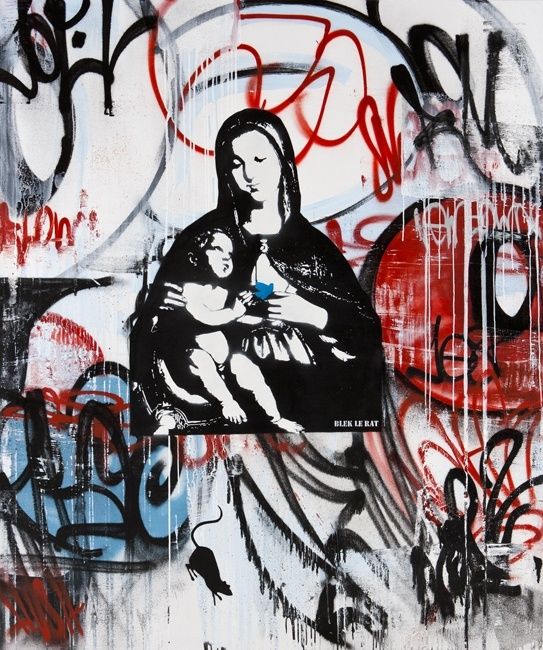
Specifically, in the art world, the environment, the media, the materials and/or the techniques used by the artists to transmit their way of seeing the universe, their message, can be decisive for the message itself.
Let’s think about some specific examples:
- Jean-Michel Basquiat, an artist who lived on the street for a couple of years, after graffiti, often expresses his “world” by painting on materials he finds lying on the street.
- Or we have Warhol using serigraphy: where the technique produces pop works in series that speak of a world where everything is mass-produced.
- Or we have the use of the gestural brushstroke, a technique that in itself implies a vision of the world or a state of mind of the artist.
- And one more example, which makes the theory irrefutable: the remembered experiment where Joshua Bell (considered the best violinist in the world) played incognito in the Washington subway, and only a couple of people stopped to listen to him. Due to the environment, no one realized that they were listening to a sublime performance.
Image: graffiti of Blek le Rat (What is valuable about the work is not the Madonna itself, but that instead of being in a church it is in the street, it is part of the street culture).
Recommended links:
Paul Klee: “Art does not reproduce the visible, rather, it makes visible.”
You can also find more material using the search engine.


0 Comments