First Abstract Watercolor
Stories behind the Works of Art
We could make this publication thanks to small donations. How is 3 minutos de arte supported?
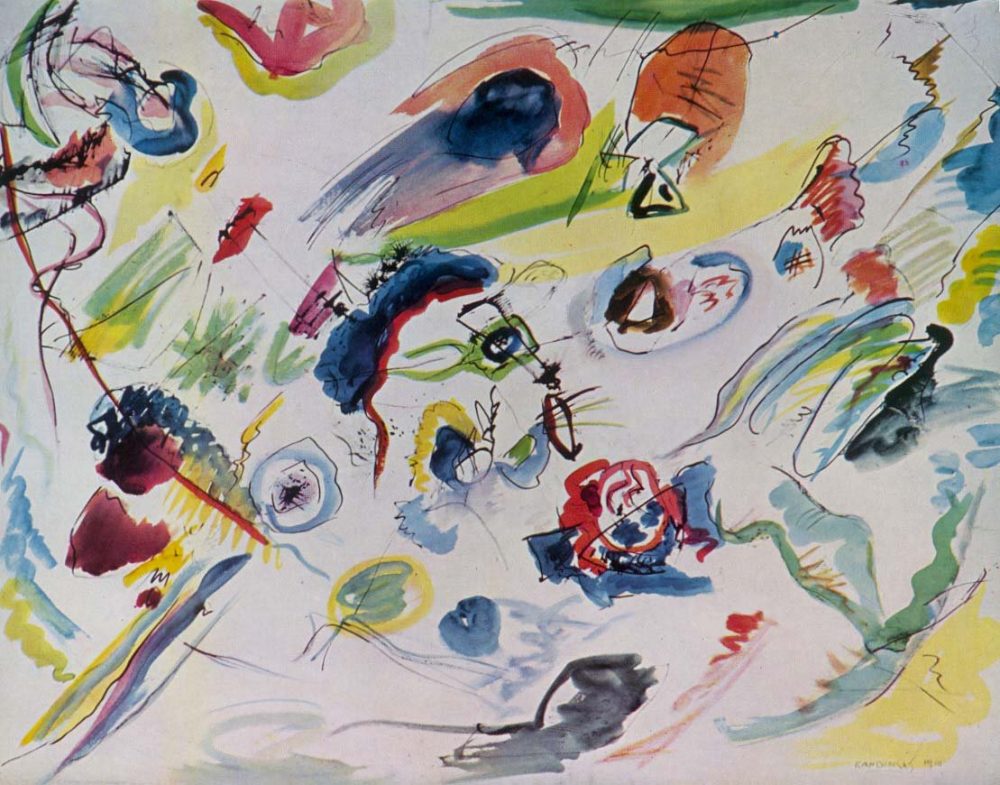
First Abstract Watercolor (?). Kandinsky.
Kandinsky realized that painting could dispense with the object; that the work could be abstract —where there is no form representing a real object— when he was in an exhibition in Moscow and his eyes fell upon a painting by Monet, one of the Haystacks series. He could not distinguish the object and was fascinated by this novelty, the absence of the object, until he read in the catalog that it was a haystack, that is, it was not abstract. Nevertheless, it was such a decisive experience for him that he would later propose that this impressionist painting be called “the first abstract painting.”
Later, when abstraction was booming, and apparently to settle the controversy about who the first abstract painter was, he called this painting —which specialists have placed around 1913— First Abstract Watercolor and said he had painted it in 1910 and signed it with that date.
Geniuses have those genial ideas.
Other artists such as Marc, Delaunay, Mondrian, in addition to Kandinsky could be considered the “fathers of abstraction.” The funny thing? It seems that Hilma af Klint preceded all of them: the mother of abstraction.
Anyway, who the first one was is not as crucial as understanding the importance of abstraction in its historical moment, when the artists were definitely ceasing to represent the world around them, choosing instead to “express” their inner world.
Kandinsky maintains in his theoretical writings that art should be a spiritual experience, and total abstraction (forms and colors that do not represent any particular object) has an expressive quality of its own and, at the same time, is very powerful in transmitting that experience. He even relates those shapes and colors to musical notes.
Artists no longer need to show how they feel or how they see the world by “transforming” or “disfiguring” that world through their emotions. They paint those emotions “directly” with colors, stains, and shapes.
Recommended links:
Kandinsky and the Abstraction.
Kandinsky and the Biomorphic Abstraction.
Timeline: Moments of Kandinsky.
You can also find more material using the search engine.
Would you like to support 3 minutos de arte?
Our project.


0 Comments