The camera obscura
Stories
We could make this publication thanks to small donations. How is 3 minutos de arte supported?
Vermeer and the Camera Obscura
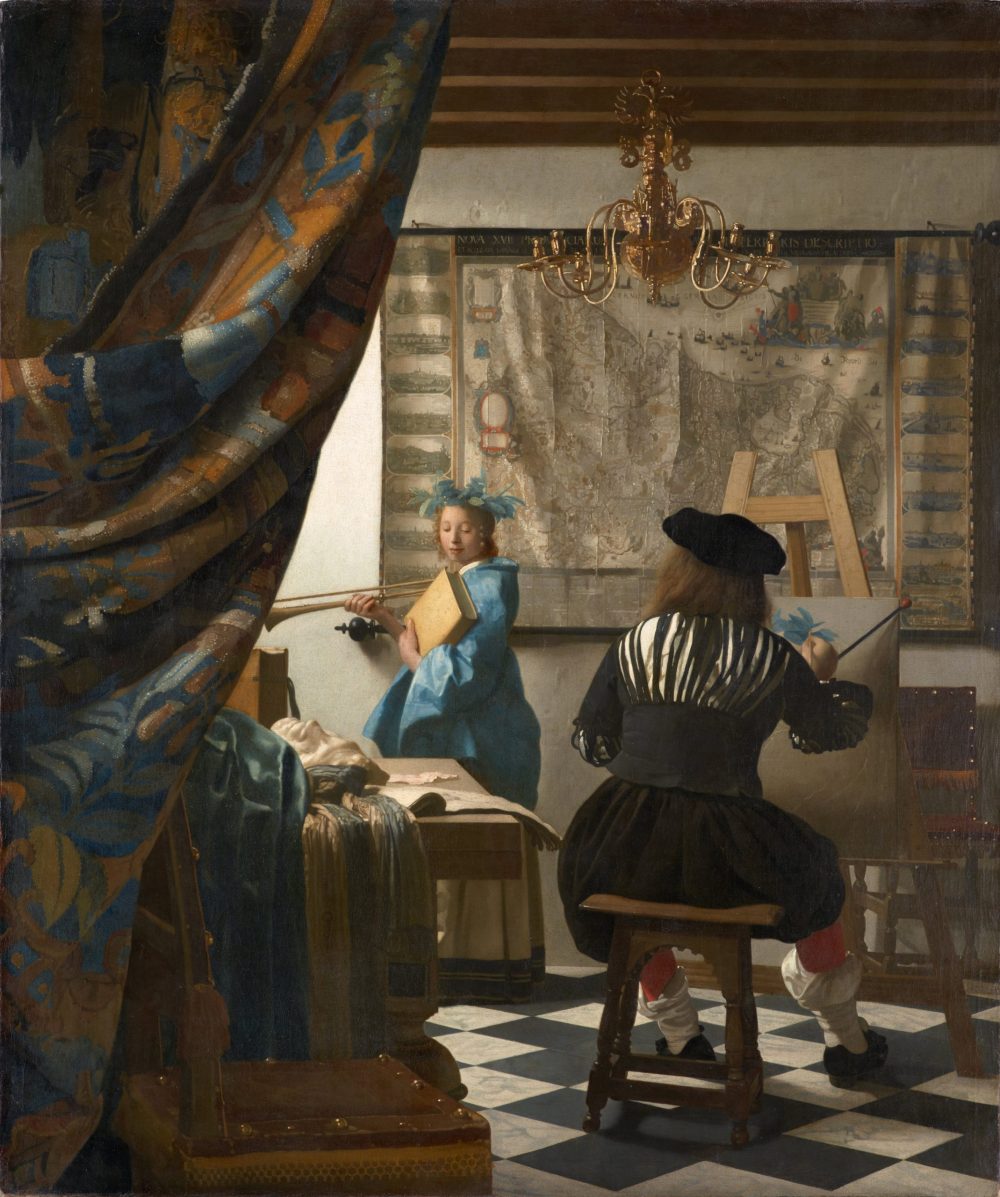
The realism and perspective achieved in the different planes of Vermeer’s works is so surprising that it has been concluded that the artist used the camera obscura to draw the compositions.
What is a camera obscura? It is the predecessor of the photographic camera. And it is actually an older discovery/invention than we might think. Originally, it was a dark room with a small hole bored into one of its walls. The light that enters through it projects on the opposite wall the image of what is outside, upside-down.
Aristotle spoke of this phenomenon caused by light passing through a small hole in Ancient Greece. And at the end of the 10th century, the Arab scholar Alhazen (some consider him to be the first scientist in history and the “father of optics”) already described the camera obscura.
In the 15th century, it was improved by Leonardo da Vinci and, in the Renaissance, Giambattista della Porta added a lens to the light entrance hole, so that the reflected image was more precise.
During the Dutch Golden Age, at the time of Vermeer, the camera obscura had become a large wooden box with a lens. The beam of light passing through it bounces off a tilted mirror (so that the projected figure is no longer inverted), and the image is reflected on a flat transparent surface. It is an image that looks as if it were a photograph, to which, if the artist places a medium with a certain degree of transparency, he can “copy” its contours. In this way, the composition achieved has a perspective that gives the “perfect” depth and volume for our eyes.
It is important to keep this in mind: in reality, the camera obscura, however “magical” it may be for its time, is only an “auxiliary” optical tool. It was not the camera that turned Vermeer into Vermeer, and his works do not seem less amazing to us now that we know that the artist surely used this “technology.”
His technical virtuosity and his artistic talent for capturing the soul of a scene are the reasons his works continue to move us today. Otherwise, they would be merely compositions with perspective and very “realistic” proportions. We would have had just something less than a photograph.
Image: The Art of Painting (ca. 1666). Vermeer
Recommended links:
Characteristic Elements of Baroque Painting.
Artistic Movements I: from Classical Antiquity to Rococo.
Dutch Golden Age (Dutch Baroque).
You can also find more material using the search engine.
Would you like to support 3 minutos de arte?
Our project.


0 Comments