Jacques-Louis David
Stories behind Works of Art
We could make this publication thanks to small donations. How is 3 minutos de arte supported?
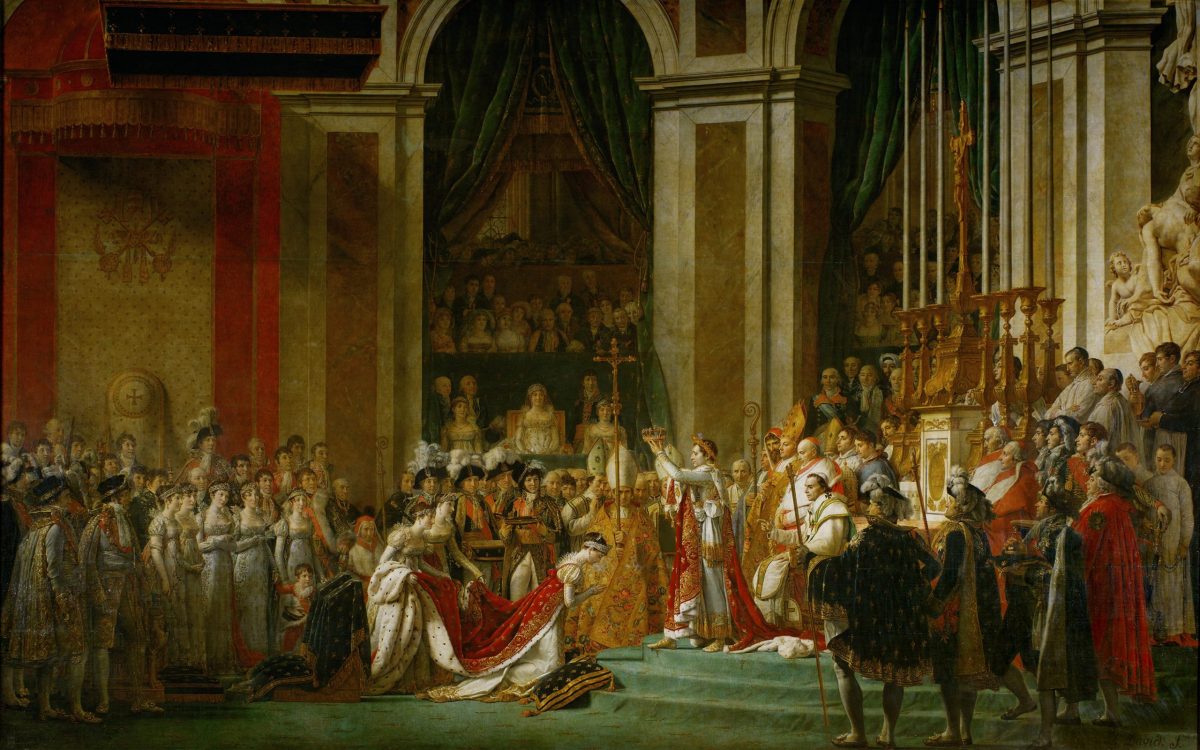
The Consecration of the Emperor Napoleon and the Coronation of the Empress Josephine (1805-07). Jacques-Louis David.
This is one of the most spectacular paintings of all the history of art.
It is huge: 6.29 m x 9.79m and very detailed. And it also represents the spectacular ceremony of the coronation of Napoleon in 1804.
Jacques-Louis David took about two years to finish it (three years after the event).
The painting has many curious details, some of them distorted, such as the presence of Napoleon’s mother, who in fact refused to be present since she disapproved of Josephine.
The most significant curious detail is based on real fact: the work at first was intended to represent the most important moment of the ceremony that was not when Napoleon crowned Josephine. The most spectacular moment of the event was when Napoleon proclaimed himself emperor, and did not let the Pope to put the crown on him, he did it himself.
Obviously, it was a gesture to show his independence from the Church, a way of showing that his power was “above God.”
There are versions that tell he took the crown form the Pope, humiliating him, but there are others telling they both agreed the Pope would give it to Napoleon so he crowned himself so as it was a less conflicting moment for the Church.
We may wonder why the painting represents Napoleon crowning Josephine instead of himself. There is a simple explanation.
Before becoming the “official” painter of Napoleon, David was the “painter of the French Revolution.” He was the most representative painter of Neoclassicism —a movement that replaced the aristocratic Rococo—. He rebelled against “decorativism and superficiality” of Rococo (as it was considered after the Revolution). He was convinced that art should convey ethical ideals such as the Revolution. It is not strange then that he changed the scene of Napoleon crowning himself with a less arrogant scene in which Napoleon crowns the empress.
Napoleon was fascinated with the result. His words were: “How great it is, how beautiful, what a relief all the objects have, what truth. It is not a painting, one walks in this painting!”
Years later, Napoleon commented that in fact Josephine had schemed this change we are talking about.
Recommended links:
Fundamental Painters of Neoclassicism.
Fundamental Paintings to Understand the History of Painting: The Raft of the Medusa, Géricault.
Stories Behind Works of Art: Lady with an Ermine, Leonardo da Vinci.
Stories Behind Works of Art: The Birth of Venus, Sandro Botticelli.
Fundamental Paintings to Understand the History of Painting: The Arnolfini Portrait, Jan van Eyck.
Stories Behind Works of Art: Ulysses and the Sirens, John William Waterhouse.
You can also find more material using the search engine.


0 Comments